

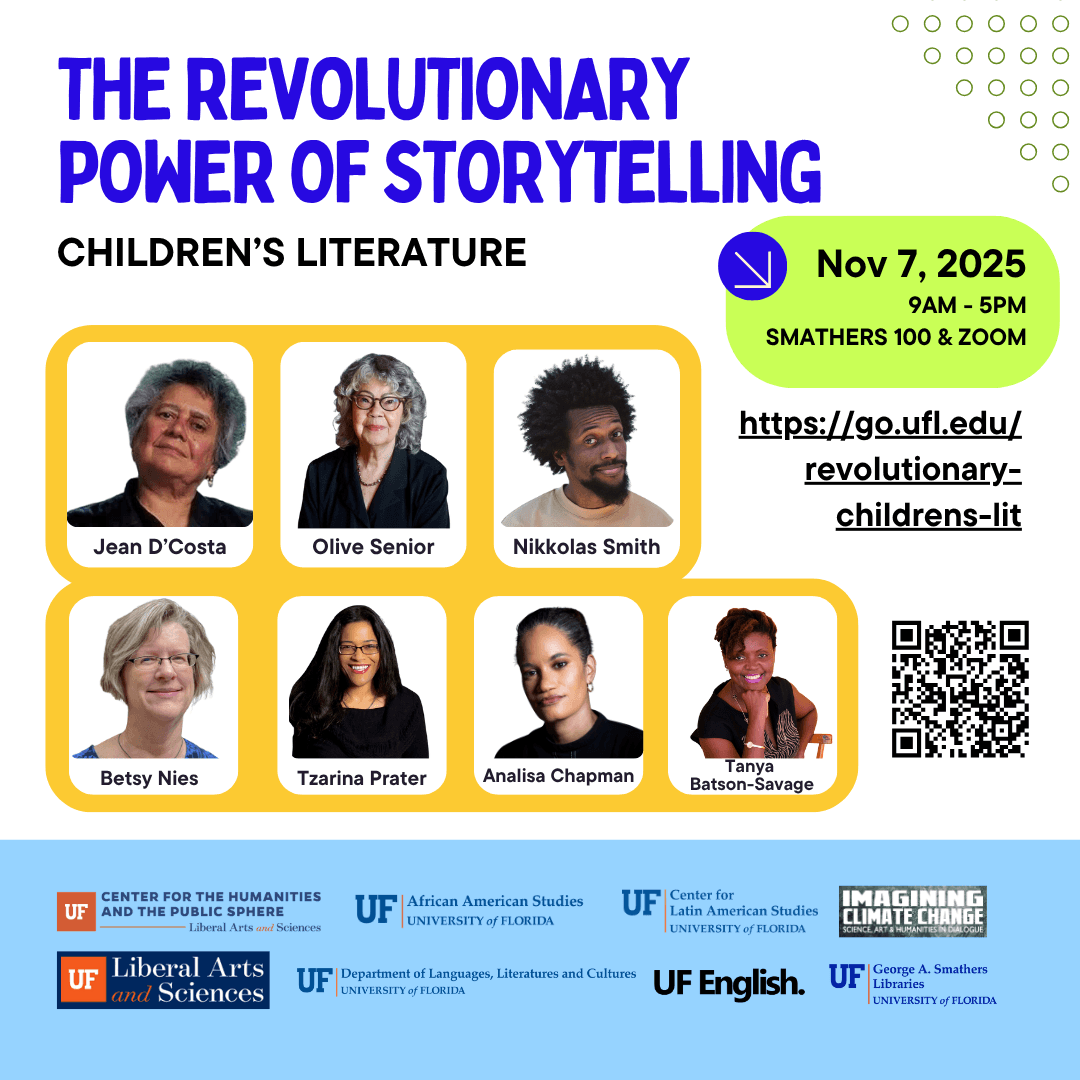
On Nov 7, 2025, the University of Florida is hosting a hybrid symposium on Caribbean children’s literature focusing in particular on the groundbreaking contributions of the Jamaican writer and linguist Jean D’Costa. See link for details. The Journal of West Indian Literature will be publishing a special issue on this topic in April 2026.
Category Archives: Conferences
Call for Papers: IACLALS Annual Conference, Bangalore, India, 12–14 February 2026
IACLALS (Association for Commonwealth Literature and Language Studies in India) announces a call for papers for their annual conference in 2026 on the theme of “Food and Food Cultures in the Global South: Aesthetics, Intersections and Mediations.” The conference will be co-hosted from 12–14 February 2026 by the Department of English, Bangalore University,
Jnanabharathi Campus, Bengaluru-560056. Please see IACLALS Annual Conference, 2026 for more details.
Call for Papers: EACLALS Triennial conference, Turin, Italy, 25-29 May 2026
EACLALS (the European Association for Commonwealth Literature and Language Studies) Triennial conference will be held in Turin on 25-29 May 2026 on the topic “Multiple Crises: Conflicts, Crossings, Migrations in Postcolonial/Decolonial Studies”. All conference details can be found on the conference website: https://corep.it/eaclals-conference-2026. All proposals must be submitted by sending an email to the organizers at ti.otinu@6202slalcae and ti.otinu@oilicnoc.nemrac. The extended deadline for paper and panel submission is 14 November 2025 (with notification of acceptance by 22 December 2025). Early-bird registration for the conference is 23 January 2026. The deadline for standard registration is 14 February 2026.
Call for Papers – 43rd Annual West Indian Literature Conference
The University of Miami, Coral Gables, Department of English & Creative Writing and Hemispheric Caribbean Studies invites submissions of abstracts for the 43rd Annual West Indian Literature Conference to be held October 8-11, 2025.
Today, Caribbean societies and, by extension, Caribbean writers, reckon with crises that feel both new and cyclical. Increased volcanic activities, record-breaking hurricanes, droughts and heatwaves are only some of the environmental pressures we face. States of Emergency in response to political and social violence have become commonplace in Haiti, Trinidad and Jamaica. As a group of Caribbean critics, we have also had to reckon with the passing of a generation that helped to establish and define our field. In its broadest sense, this year’s Conference of West Indian Literature, convened around the theme, ‘The Time of the Bruggadung: States of EmUrgency,’ asks the simple question: what are Caribbean writers reckoning with today?
That almost comic word of Bajan creole, ‘bruggadung’, becomes something even larger than the onomatopoeic sound of a bang or commotion in the mytho-poetic world of Brathwaite. Instead, it becomes the sound of environmental disaster (“all uh know/ is that one day suddenly so/ this mountain leggo one brugg-a-lung-go” – “The Dust”), or else the sound of social and cultural disaster (“but leh murder start an’ bruggalungdung/ yu cahn fine a man to hole up de side.” – “Rites”), or even the sound of the collapse of Apartheid (‘bongo man a come/ bongo man a come/ bruggadung’ – “Soweto”). Always, the bruggadung signals a time of reckoning.
For this convening of the conference, we are particularly interested in papers that might approach the theme in a broad context. Critical considerations might include:
How have Caribbean writers and other cultural producers been engaged in ringing the warning bell to alert us of the impending social and environmental urgencies of the time?
To what extent has Caribbean literature historically grappled with the intersection of natural disasters and colonial legacies, and how have these narratives foreshadowed the Anthropocene’s emergence as a dominant paradigm?
How has a new generation of Caribbean writers understood and reimagined the emUrgencies of their own times? Moreover, how might we understand these generational differences and the new dialogues that may be required from its critics?
In a world increasingly characterized by physical and ideological barriers, how might the expansive imaginative landscape of mytho-poetics foster cross-cultural understanding and solidarity in the face of various social, economic, and environmental challenges?
Given the prominence of “resilience” discourse in disaster contexts, how have cultural producers challenged the prevailing narratives of trauma and immobility, offering alternative modes of representation that empower affected communities?
For full details, please see: CFP-The 43rd Annual West Indian Literature Conference
Deadline for abstracts: April 2, 2025
Notifications of acceptance: May 15, 2025
Call for Papers – Precarious Planet: Disability, Rights and Justice
Call for papers for a conference being hosted from 29 November – 1 December 2023 at the University of Wollongong, Sydney Campus, Australia. The conference is being convened by Challenging Precarity: A Global Network (CPGN) and the South Pacific Association for Commonwealth Literature and Language Studies (SPACLALS). The organisers invite scholars and experts from disciplines in the humanities, especially in literary, visual and cultural studies, as well as those working in the social sciences, to examine multiple frameworks, methodological approaches, and critical lenses in contextualising the theme “Precarious Planet: Disability, Rights and Justice”, and to provide interventions into the pressing concerns of our present times and future lives. Papers considering the relation between the conference theme and the situation(s) of precarity in the Global South are strongly encouraged. Global and local indigenous Pacific, Aotearoa New Zealand, and First Nations Australian perspectives will be particularly considered. For more details, consult https://southpacificaclals.wixsite.com/website/about-1
Submission of abstracts: 1 July 2023
Acceptance email: 18 August 2023
Call for Papers – 41st Annual West Indian Literature Conference
Hosted by the University of the West Indies, Mona Campus (Kingston, Jamaica), the 41st Annual West Indian Literature Conference invites papers and panel proposals that explore the critical connections in Caribbean literary and cultural studies. With this year’s focus on connections, the conference seeks to bring together academics, postgraduate students, creative practitioners, secondary school educators, and the general public to both critically assess the literature and celebrate the scholarly analysis of West Indian (Caribbean) literary artists. This gathering also takes the opportunity to recognize the connections between West Indian music and West Indian writing. It will honor the life and brilliant cultural criticism of the late Professor Emeritus Gordon Rohlehr (UWI, St Augustine). It will also celebrate the 30th anniversary of the publication of Noises in the Blood by Professor Emerita Carolyn Cooper (UWI, Mona) and Woman Version by Professor Emerita Evelyn O’Callaghan (UWI, Cave Hill). These two texts continue to inspire scholars to make new critical connections among gender, music, orality and literature. See full call here – WILC 2023 CFP
The Caribbean Digital VII to be held virtually, with three asynchronous digital community projects and a synchronous gathering on December 4, 2020
From the organizers –
“This year, the seventh annual Caribbean Digital event will be held virtually, with three asynchronous digital community projects and a synchronous gathering.
Currently, we are in the midst of collecting entries for one of the three community projects, our Directory of Caribbean Digital Scholarship. To suggest projects for inclusion in the Directory, you are invited to add links and annotations to our master spreadsheet between October 26 and November 20.
We are also gearing up for our Collective Annotation of Aimé Césaire’s Notebook of a Return to My Native Land, which will run November 16 to 20. This event offers our community an opportunity to engage Césaire’s work in ways that will generate an original textual artifact. Please sign up here to receive timely information regarding participation in this venture.
Our third valence, a Keyword Collection for Caribbean Studies, initiates a collaborative exploration of words that serve as rich sites for research and pedagogy in Caribbean Studies. This collection is intended to be the beginning of a project that will grow with future Caribbean Digital events.
We are excited to work on these three projects with you. Please contact us at moc.liamg@latigidnaebbiraceht
CFP: West Indian Literature Conference, University of Guyana, 17-20 Oct 2019
Deadline for submission of abstracts: 20 June 2019
Notification of acceptance: 30 June 2019
Submissions are invited for the 38th Annual West Indian Literature Conference, to take place at the Turkeyen Campus of the University of Guyana, 17-20 October 2019.
The conference theme is “HINTERLANDS: Journeys of the Imagination,” which in the words of the organizers “will include the foundations: some special attention to the heritage(s) of Wilson Harris, Derek Walcott, V.S. Naipaul”; a focus on film and technology; and examinations of the Guyanese experience.
Papers on the following themes are also especially welcome:
- images
- the visual arts (the fine arts)
- oral literature
- performance traditions
- theatre
- dance hall
- chutney
- soca
- spoken word and performance poetry
- creole languages
More information here: WILC 2019 CFP
CFP – CACLALS at Congress 2019, Vancouver – d/line 1/15/19
Canadian Association for Commonwealth Literature and Language Studies
CFP: CACLALS at Congress 2019 University of British Columbia (Vancouver, B.C.)
June 1-3, 2019
“Listening and Speaking: Postcolonial Circles of Conversation”
Confirmed Keynote Speakers:
Dr. David Chariandy (Simon Fraser University)
Prof. Jasbir Puar (Women and Gender Studies, Rutgers University)
From the organizers:
In the spirit of postcolonial circles of conversation, we invite papers, panels, roundtables and workshops to reflect on critical, theoretical and creative acts of listening and speaking. What are the conversations that the “postcolonial” has failed to adequately address? What are the silences, gaps or points of erasure in postcolonial circles of conversation? What are the new conversations generated by or beyond the field, in terms of new theoretical crossroads or points of intersection, new forms of alliance, new acts of cross-cultural listening, new comparative mappings, etc.? How do we approach modes of listening in the context of indigenous knowledge (such as notions of “deep listening”)? How does listening occur across species boundaries? How does the aesthetic or creative, more generally, facilitate original modes of listening and speaking?
CACLALS welcomes conference paper or panel proposals that address any aspect of the CFP’s central questions or issues. We also welcome proposals otherwise related to the Association’s broader mandate to examine postcolonial and global literatures.
Proposals of approximately 350 words should be sent by January 15, 2019, as a Word doc. attachment to ac.slalcac@ofni with the subject heading of “CACLALS Proposal at Congress 2019.”
Conference queries should be sent to CACLALS President, Dr. Mariam Pirbhai: ac.slalcac@ofni.
More details here.
CFP: Caribbean Science/Speculative Fiction Symposium
November 23, 2018
UWI Cave Hill, Barbados
CFP deadline: June 29, 2018
From the organizers:
The Department of Languages, Linguistics and Literatures at the University of the West Indies Cave Hill is inviting papers that explore themes related to Caribbean speculative fiction. The last two decades have seen an increase in the publication of SF works by Caribbean writers who bring a Caribbean sensibility to a genre that has been steadily gaining global academic recognition. These works encourage a re-examination of what constitutes Caribbean literature. They also challenge us to examine the nature of Caribbean SF, to ask how it differs from other geo-political/cultural writings in the genre, and whether or not writing in this genre helps us to understand the Caribbean’s presence on the global stage.
Abstracts of 250 words and a brief biographical note should be sent by Friday, 29 June 2018 to:
-
Andrew Armstrong: ude.iwu.llihevac@gnortsmra.werdna
-
Richard Clarke: ude.iwu.llihevac@ekralc.drahcir
-
Nicola Hunte: ude.iwu.llihevac@etnuh.alocin
-
Debra Providence: ude.iwu.llihevac@ecnedivorp.arbed
For more details, see Caribbean Commons post here.
